

Unlike traditional sales or service models, nonprofits often serve walk-ins, members, or partner organizations without a predictable lead-to-opportunity flow – which means organizations that utilize Salesforce must adapt to informal, people-centered relationships rather than transactions.
Managing nonprofit programs in Salesforce takes thoughtful planning and implementation. This is in large part due to the fact that nonprofits can deliver services in various forms such as community events, volunteer initiatives, training programs, and/or membership councils to name a few. Each has its own data, goals, and people involved, but rarely a single structure to tie it all together.
That’s why the Growth Heroes team spends so much time helping nonprofits design smarter program management models in Salesforce. When it’s done well, Salesforce can surface insights about participation, outcomes, and impact that might otherwise stay hidden in spreadsheets or staff notes.
What is Nonprofit Program Management?
Nonprofit program management involves overseeing and monitoring the services provided by nonprofit organizations. In contrast to many for-profit entities, nonprofits focus less on products and more on intangible services, which can be paid or unpaid. The way clients engage with these services can sometimes be informal—such as a person simply walking into a center and signing up, rather than being tracked as a lead or opportunity. This creates a unique frame of reference for tracking and measuring engagement…whether you are working with members of a board or council, families with kids enrolled in a therapeutic program, or educators receiving classroom robotics kits.
Some key aspects of nonprofit program management include:
- Services may be delivered to individuals, organizations, or both.
- The progression of services (e.g., when did they start/stop and why?) is a key part of lifecycle management.
- Engagement metrics are crucial for understanding how people use services.
- Qualitative notes from staff often supplement quantitative data.
As nonprofits grow and diversify their services, the tools they use to track programs must evolve too. This often leads our prospects and clients to a critical question: which Salesforce model best fits the organization’s needs?
Choosing the Right Model for Nonprofit Program Management in Salesforce
One of the first architectural decisions for a nonprofit implementing Salesforce is whether to use a nonprofit-tailored product such as Nonprofit Cloud or the Nonprofit Success Pack (NPSP); or, to stick with standard Salesforce Sales Cloud.
Salesforce’s nonprofit offerings include predefined modules and data models for managing programs, outcomes, donations, and relationships. These can save setup time and align with common nonprofit use cases, but they also introduce a more rigid structure. Both Nonprofit Cloud and NPSP are designed around individuals and households, which may not fit organizations that operate through councils, institutions, or partnerships.
If your organization primarily tracks straightforward metrics such as attendance counts, volunteer hours, or event participation – a custom configuration of standard Salesforce may meet your needs without the overhead of Nonprofit Cloud. On the other hand, organizations managing outcomes, benefits, or case workflows may benefit from its built-in structure.
Choosing between a nonprofit-specific model and standard Salesforce comes down to flexibility versus structure. The nonprofit products can accelerate implementation, but once adopted, they’re difficult to unwind without a full rebuild. Standard Salesforce, on the other hand, provides more freedom to model data around your unique operations — but requires greater upfront configuration and ongoing governance.
Consider these points:
- Nonprofit Cloud is a paid, advanced solution.
- The model is centered on individuals and households.
- Reversing the decision is difficult; migration options are limited.
Once a foundational data model is chosen, the next step is deciding how to structure everyday activity tracking – from events and donations to program participation.
Campaigns, Opportunities, and Custom Objects
It’s common for our team to find legacy nonprofit Salesforce setups where Campaigns or Opportunities have been repurposed for nearly every process…from tracking board memberships to internal meetings. This can make reporting and automation challenging over time.
Nonprofits often use Salesforce campaigns and opportunities in creative ways, especially those that have not recently implemented Salesforce.
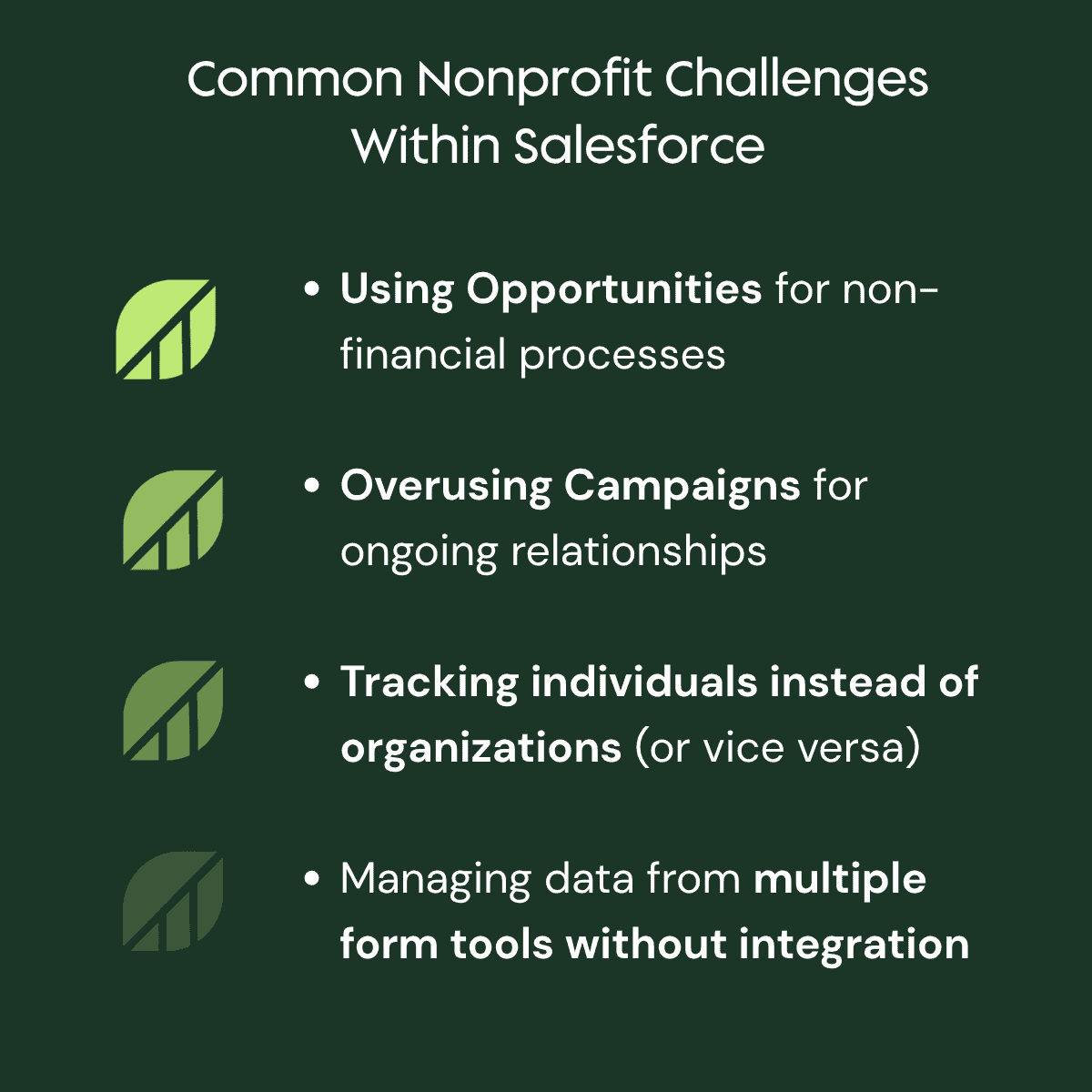
Campaigns are popular for grouping people for events, meetings, or boards, thanks to their ease of use and import functionality. Opportunities, with their stages and funnel, are sometimes used to track processes even when no money is involved, which can lead to confusion.
The best practice is to use opportunities for financial transactions and transition to custom participation or enrollment objects for ongoing program tracking.
Key details:
- Campaigns are best for events and one-time activities.
- Opportunities should be used when money is involved.
- Custom participation or enrollment objects track ongoing engagement and lifecycle.
Even with the right objects in place, clarity on who you’re tracking…individuals, organizations, or both…is just as important for accurate data and reporting.
Individuals, Organizations, or Both?
Defining the program management model requires understanding whether the focus is on individuals, organizations, or a blend of both. For instance, an organization might track event participation by company representation rather than by the individual attendee – ensuring that credit stays with the organization…not the person who happened to attend.
On the other hand, some nonprofits need to track both levels, such as organizations purchasing services on behalf of multiple individuals. Metrics may be based on individual participation, organizational representation, or a combination. Custom fields and picklists can help distinguish between individual and organizational services, ensuring accurate tracking and reporting.
Highlights:
- Some programs require tracking both individuals and organizations.
- Engagement metrics may be based on either or both.
- Custom fields help clarify service types.
These distinctions quickly become more complex when nonprofits must connect individual and household data, or tie contacts to organizations and roles.
Households, Affiliations, and Person Accounts
Special consideration should also be given to the task of managing households, affiliations, and person accounts in Salesforce. Nonprofit Cloud associates contacts with households by default, enabling aggregate views of donations and volunteer activity. Affiliations track relationships with organizations, employers, and educational institutions. For nonprofits focused solely on businesses, the Growth Heroes team has seen the household model become cumbersome at times, requiring workarounds to hide or merge household records.
Notable details:
- Households aggregate individual contributions.
- Affiliations track organizational relationships.
- Person accounts offer an alternative but add complexity.
Of course, clean data models only work when the information coming in is reliable (and, ahem…”clean”). That’s where data intake and integration play a pivotal role.
Data Intake and Integration
Data intake is a significant challenge for nonprofits, especially those without dedicated staff for data entry. External form tools like Formstack or JotForm are commonly used to collect information from volunteers, clients, or partners who do not have Salesforce access. For complex processes, such as university applications, specialized tools like SurveyMonkey Apply may be integrated with Salesforce.
These tools help bridge the gap between external participants (e.g., volunteers, tutors, or applicants) and Salesforce, reducing manual data entry and keeping engagement data connected. The key is to ensure that data collected externally can be efficiently synced back to Salesforce for reporting and analysis.
Important considerations:
- External forms are often used for data collection.
- Integration with Salesforce is essential for reporting.
- Specialized tools may be needed for complex intake processes.
When configured effectively, these data foundations have unlocked meaningful insights for many of our clients. Dashboards and reports can then turn participation data into actionable strategy.
Real-World Examples and Salesforce Dashboards
Many nonprofits use Salesforce campaigns to track participation in events, programs and initiatives – with custom fields helping to capture organizational or constituent representation at the time of engagement. These participation records form the foundation of engagement scoring models, which evaluate involvement across multiple dimensions such as attendance, membership activity, and contribution history. Salesforce dashboards then bring the data to life, visualizing trends in engagement, program reach, and regional representation. Key points:
- Participation records provide the backbone for engagement scoring.
- Dashboards reveal trends in performance, reach and representation.
- Custom fields help track key details about organizational participation.
With great insight, however, comes the responsibility to manage access carefully. Nonprofits must balance visibility with privacy to maintain trust and compliance.
Data Security and Access Challenges in Nonprofit Program Management
Finally, consideration should be given to evaluating potential challenges related to data security and access, especially when individuals transition from program participants to staff members. Ensuring appropriate access to sensitive records requires careful configuration of sharing rules and security settings. In some cases, organizations resort to maintaining separate Salesforce orgs to keep data distinct, though this is not an ideal solution.
Key challenges:
- Managing access for multi-role individuals is complex.
- Sharing rules and security settings must be carefully configured.
As these examples show, there’s no single right setup, but there is a right architecture for your organization’s mix of services, stakeholders, and goals.
Simplifying Nonprofit Program Management Complexity With Smart Architecture
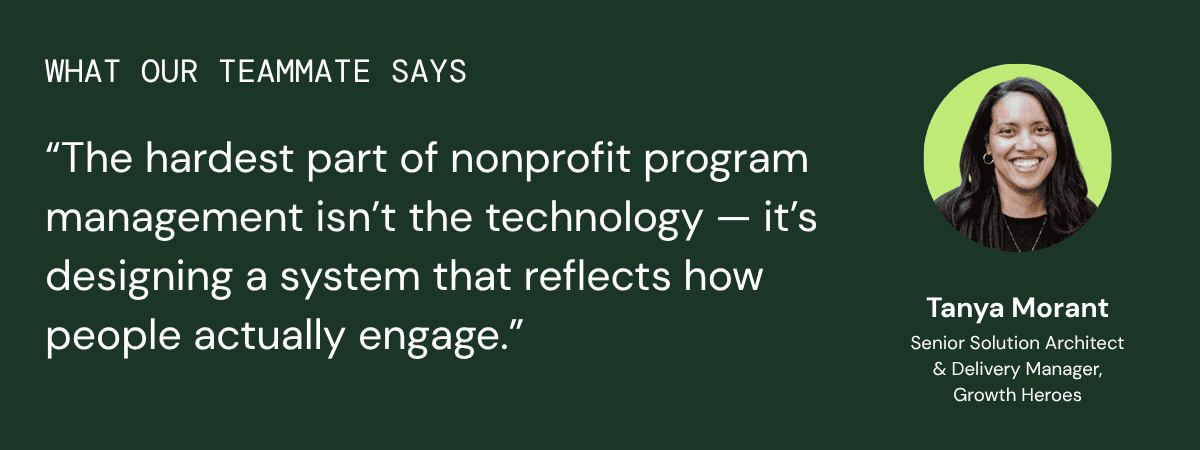
Nonprofit program management in Salesforce isn’t just about configuring the right objects — it’s about designing a system that reflects how your organization actually delivers impact. Whether you’re tracking volunteer engagement, program outcomes, or member participation, the structure behind your data determines the clarity of your insights.
At Growth Heroes, we help nonprofits build Salesforce environments that simplify the complex — connecting people, programs, and outcomes in one clear view. If your team is ready to make program management more measurable and sustainable, reach out to start a conversation or explore how we’ve helped similar organizations streamline their operations.