

Through our work connecting marketing systems with Salesforce, we’ve seen how B2B revenue rarely traces back to a single touchpoint. For example, a prospect might first discover your company through a LinkedIn campaign, attend a webinar later, then engage with an email message, and finally submit a form before an opportunity ever appears in Salesforce.
When that eventual opportunity closes, we should also ask how those marketing interactions might be connected to pipeline and revenue in a way that supports consistent measurement and better business decisions.
That’s where campaign influence becomes important. By understanding the role of different metrics and creating a thoughtful attribution framework in Salesforce, organizations can connect marketing activity with opportunities, evaluate performance across different channels, and build a clearer foundation for measuring return on advertising spend (ROAS).
The value of the ROAS calculation comes from the framework behind it:
- how campaigns are connected to opportunities,
- how influence is assigned across multiple touch points,
- how marketing costs are considered, and
- how the timing of a B2B sales cycle affects the analysis.
Three Levels of Marketing Measurement
Marketing teams have no shortage of metrics available to measure performance. But those metrics become more valuable as they connect marketing activity with broader business outcomes.
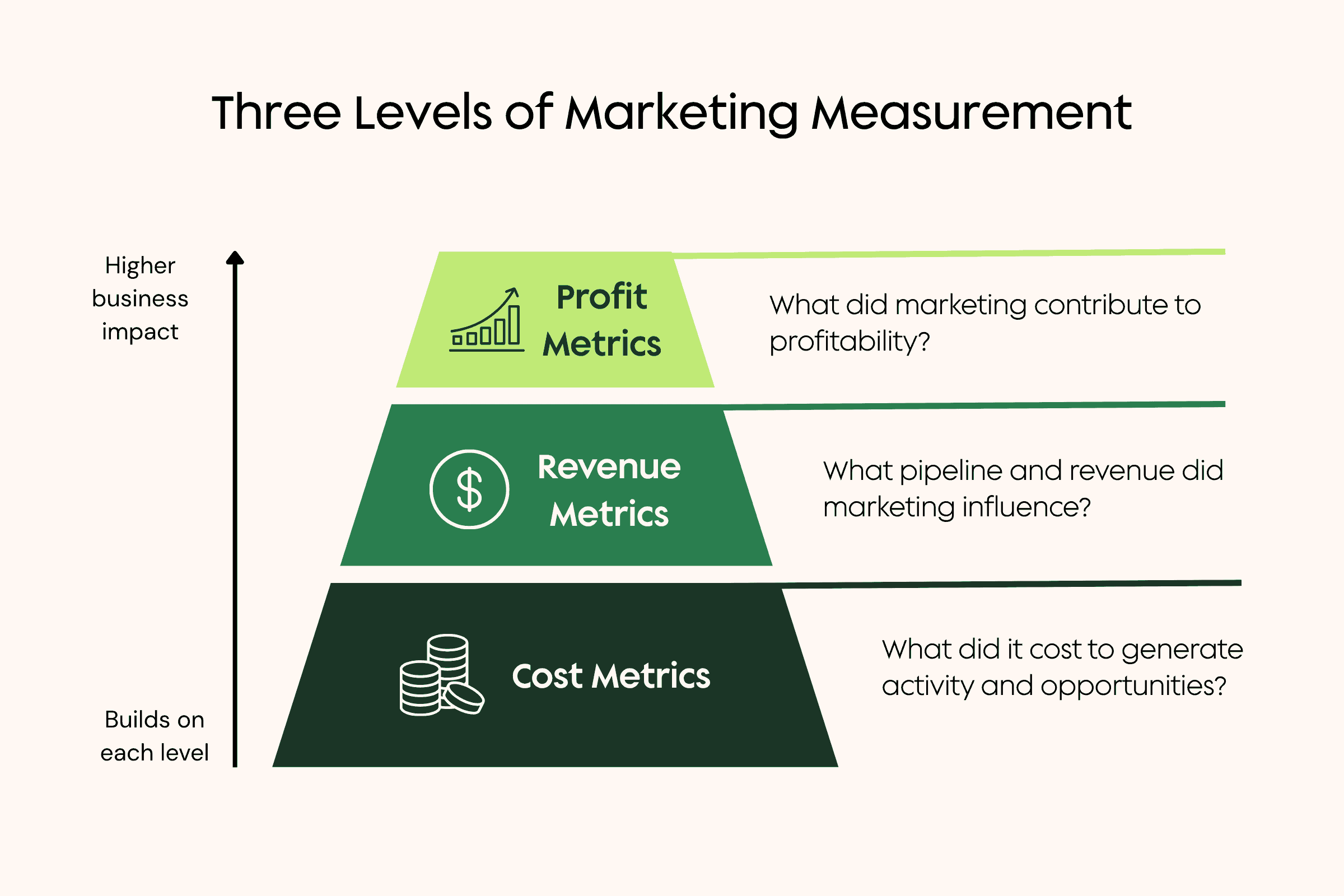
We tend to think about marketing measurement in three broad categories:
- Cost metrics measure what it takes to generate activity and move prospects through the funnel. These include metrics such as cost per click (CPC), cost per lead (CPL), cost per opportunity (CPO), and customer acquisition cost (CAC).
- Revenue metrics connect marketing activity with pipeline and revenue. Metrics such as attributed pipeline, attributed revenue, and return on ad spend (ROAS) help organizations understand what their marketing investments are contributing to the sales process and ultimately generating in revenue.
- Profit and margin metrics take the analysis another step by connecting attributed revenue with financial data. When that information is available, organizations can evaluate marketing investments based not only on the revenue they help generate, but also on their contribution to margin and profitability.
Together, these three levels create a progression from understanding what marketing costs to understanding what it contributes to the business.
ROAS is Simple. Attribution Makes It Meaningful.
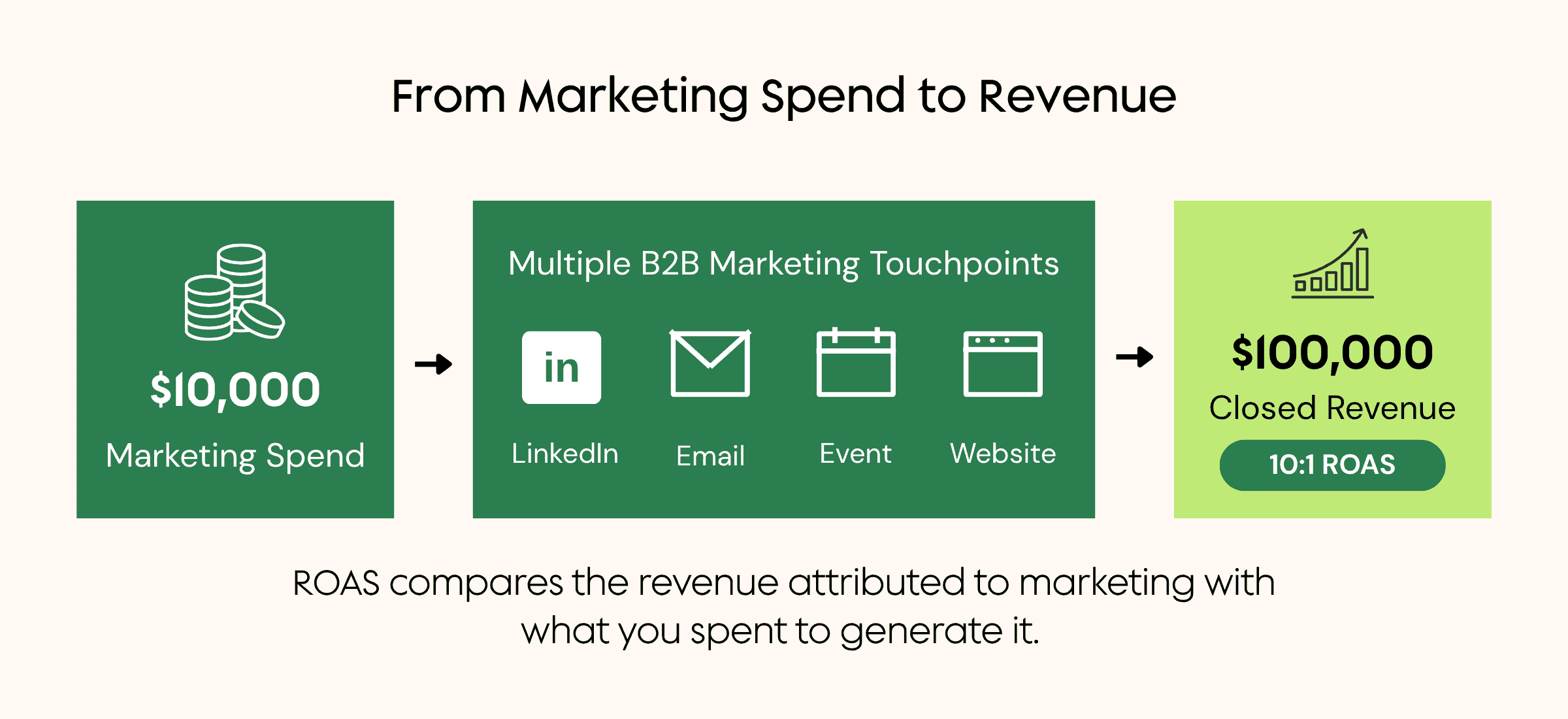
ROAS sits within the revenue level of this framework because it compares the revenue attributed to marketing with what you spent to generate it.
Spend $10,000 and attribute $100,000 in revenue to that investment, for example, and the resulting ROAS is 10:1.
In our experience, this is where marketing reporting often becomes more valuable to leadership. The conversation shifts from activity and conversion metrics to how marketing contributes to pipeline and revenue.
The math is straightforward. The more interesting question for a B2B organization is: How did you arrive at the $100,000 in revenue?
A prospect may have interacted with several campaigns before becoming a customer. When multiple campaigns and prospect touchpoints contribute to an opportunity over a longer sales cycle, connecting revenue to marketing spend requires a consistent approach to campaign influence.
That means understanding which campaigns played a role, deciding how revenue credit should be distributed among them, and applying that methodology consistently.
This is what turns ROAS from a simple calculation into a useful decision-making tool.
Attribution Starts With Reliable Source Data
Before revenue can be attributed to a campaign, Salesforce needs a consistent way to understand where marketing engagement originated.
For digital campaigns, that often begins with UTM parameters and other source data captured through forms, landing pages, and marketing automation platforms. Events, webinars, referrals, and other offline or sales-assisted activities can also become part of the attribution picture when they are represented consistently in Salesforce.
Salesforce marketing automation platforms and related marketing technologies can help capture and preserve engagement and source data as prospects move through the customer journey. Depending on the organization’s technology stack, that might involve
- Marketing Cloud Account Engagement (Salesforce’s established B2B marketing automation platform, formerly known as Pardot),
- Marketing Cloud Next (Salesforce’s next-generation agentic marketing platform),
- analytics and advertising platforms,
- website forms, or
- other tools that pass meaningful source and campaign data into Salesforce.
Our approach will vary by each client’s technology stack, but the guiding principle stays the same: useful campaign and source data needs to remain connected to the prospect as marketing engagement becomes sales activity.
Rather than tracking every interaction for the sake of it, the focus should be on preserving enough meaningful source information to connect marketing engagement with leads, contacts, campaigns, opportunities, and ultimately revenue.
Attribution will rarely be perfect. In fact, privacy preferences, longer buying journeys, multiple devices, offline interactions, and incomplete source data can all affect what gets captured.
A useful B2B attribution framework should account for those imperfect realities without abandoning measurement altogether. Consistent source data and clear campaign definitions can still provide a reliable basis for comparing performance over time and making better investment decisions.
Useful attribution comes from consistency, even when modern privacy settings mean every marketing touch can’t be captured.
Give Campaign Influence a Consistent Structure in Salesforce
Once source data is captured consistently, Salesforce needs a campaign structure that reflects how the business wants to evaluate marketing performance.
Salesforce Campaigns can represent the marketing activities that contribute to a B2B customer journey…from digital advertising and webinars to events, email programs, content offers, and other initiatives.
Having a standardized structure matters because different stakeholders need different levels of insight. For example, a marketing manager may want to compare individual campaigns, while executive leaders may care more about how broader channels or programs contribute to pipeline and revenue.
One of our best practices is to start with the reporting questions. The way campaigns are organized in Salesforce should reflect how marketing teams and business leaders actually want to evaluate performance.
- Which activities should be measured individually?
- Which should roll up into broader programs or channels?
- What counts as meaningful engagement?
- And how should campaign activity connect with opportunities as prospects move through the sales process?
Having consistent definitions for leads, opportunities, pipeline stages, and closed revenue also helps ensure marketing and sales are measuring performance against the same customer journey.
Choose an Attribution Model Based on the Question You Want to Answer
Salesforce Campaign Influence helps connect marketing campaigns with the opportunities they may have influenced. Once those relationships are established, attribution models determine how revenue credit is assigned across the campaigns involved in the customer journey.
For a B2B organization, a single opportunity may involve multiple marketing interactions over weeks or months. Consider a hypothetical $100,000 opportunity where the prospect interacted with four campaigns before becoming a customer in the following image.
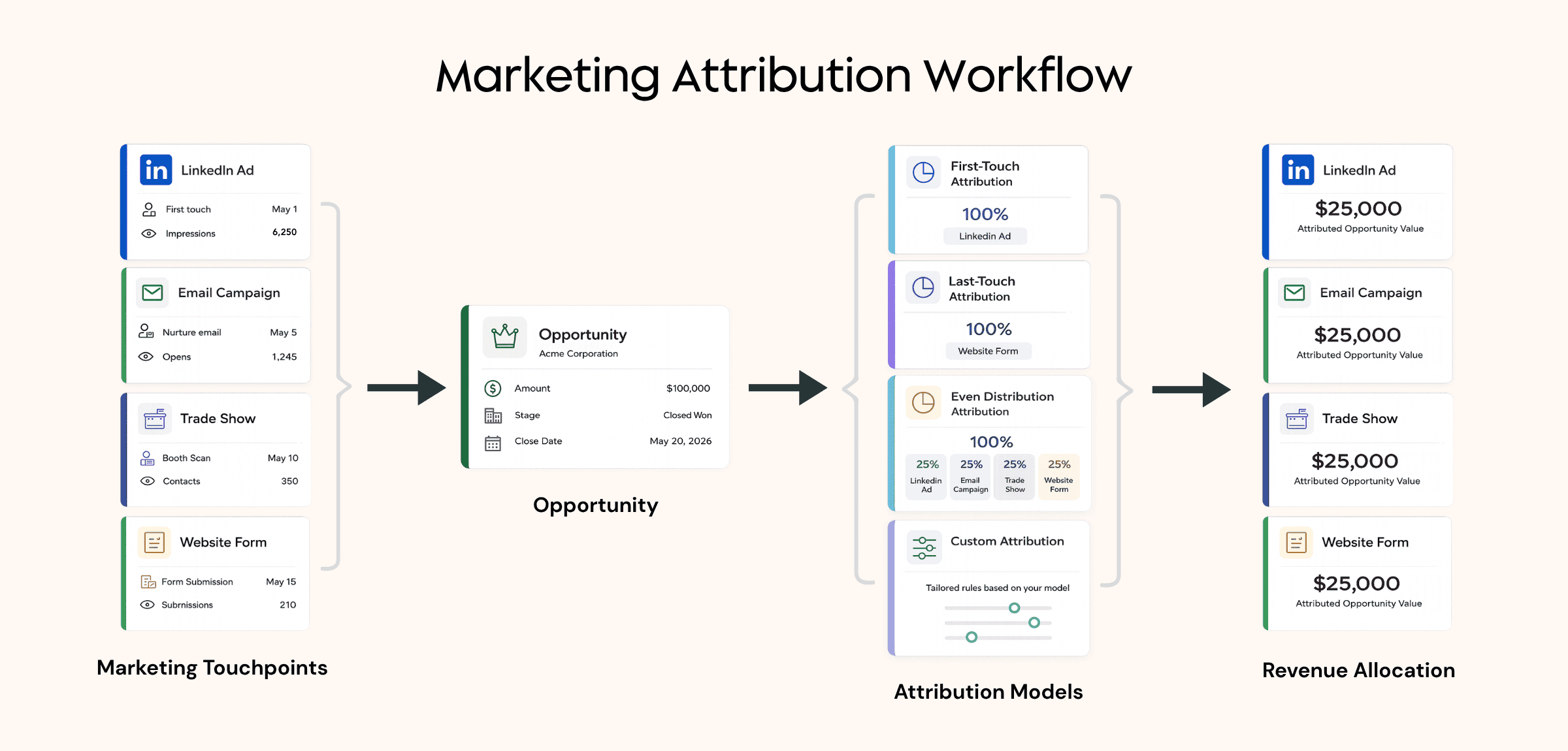
Each interaction contributed to the journey, but there are different ways to evaluate that influence.
So how do you attribute revenue to campaigns? Salesforce offers multiple attribution models to help you determine the story that your reporting will tell.
Primary Campaign Model
Which single campaign should be treated as the primary source for this opportunity?
Salesforce opportunities can identify a Primary Campaign Source, associating the opportunity with one campaign. This is the default model. The opportunity has a Primary Campaign field. If you populate it and the opportunity is worth $100,000, that campaign gets credit for the full $100,000 in attributed opportunity value.
This default model provides a straightforward primary relationship, but it tells a different story than multi-touch Campaign Influence when several campaigns contribute to a longer B2B journey.
First Touch Attribution
What originally brought this customer into our marketing ecosystem?
This model gives credit to the first campaign or UTM parameter that touched the contact. Where did they first come from? A website? An ad? A LinkedIn campaign? That campaign gets the credit. In our hypothetical example, the LinkedIn Ad would receive credit for the $100,000 opportunity.
This perspective can be useful when evaluating which campaigns and channels are most effective at introducing new prospects to the business.
Last Touch Attribution
Which marketing interaction occurred closest to the opportunity?
Credit goes to the last campaign a prospect interacted with before closing. Maybe they downloaded a white paper, attended a webinar, or clicked a retargeting ad. In our hypothetical example, the website form would receive the $100,000 in attributed revenue.
This view can help organizations understand which marketing activities tend to occur later in the buying journey.
Even Distribution Attribution
What if we want to recognize every campaign that contributed to the journey?
In this model, attribution is spread across all campaigns with which the contact engaged. With four campaign touches influencing our example’s $100,000 opportunity, each would receive $25,000 in attributed opportunity value.
This model can provide a broader view of marketing influence when B2B opportunities involve multiple meaningful interactions.
Custom Attribution
What if some interactions should carry more weight than others?
A custom attribution model can reflect business-specific assumptions about how different interactions contribute to an opportunity. An organization might decide, for example, that certain high-intent activities deserve more influence than earlier awareness touches.
The important consideration is whether the additional complexity produces a more useful business perspective, rather than simply a more complicated attribution model.
Growth Heroes can customize Salesforce to support a client’s unique attribution model preferences. In our experience, the most useful attribution model is not necessarily the most sophisticated one. It’s the one that answers a meaningful business question, is understood by the people using the reports, and can be applied consistently over time.
Connect Attributed Revenue to Marketing Spend
Once campaign influence is established, the next step is bringing marketing spend into the same measurement framework. This is what allows organizations to move from cost metrics toward revenue metrics.
That means connecting the cost of campaigns and channels with the opportunities and revenue attributed to them. When those data points are available together, organizations can move beyond engagement metrics and begin evaluating marketing investments in financial terms.
The important part is the consistency of the data behind the analysis. Campaign costs, attributed revenue, and the attribution model all need to reflect the same measurement approach so comparisons across campaigns, channels, and time periods remain meaningful.
We’ve found that this is where Salesforce can become especially valuable for B2B organizations: marketing performance can be evaluated alongside opportunity, pipeline, and revenue data rather than in a separate reporting environment.
B2B ROAS Needs to Account for Sales Cycle Timing
One pattern we regularly see in B2B reporting is that marketing spend and the revenue it influences are evaluated in the same calendar period even when the underlying sales cycle spans several months. You might advertise in July, land a lead in August, and close the deal in October. You can’t say “I spent X in July and got Y closed deals in July.” That timing matters, and you need to account for the lifecycle to avoid understating the value of campaigns that are still working through that longer sales cycle.
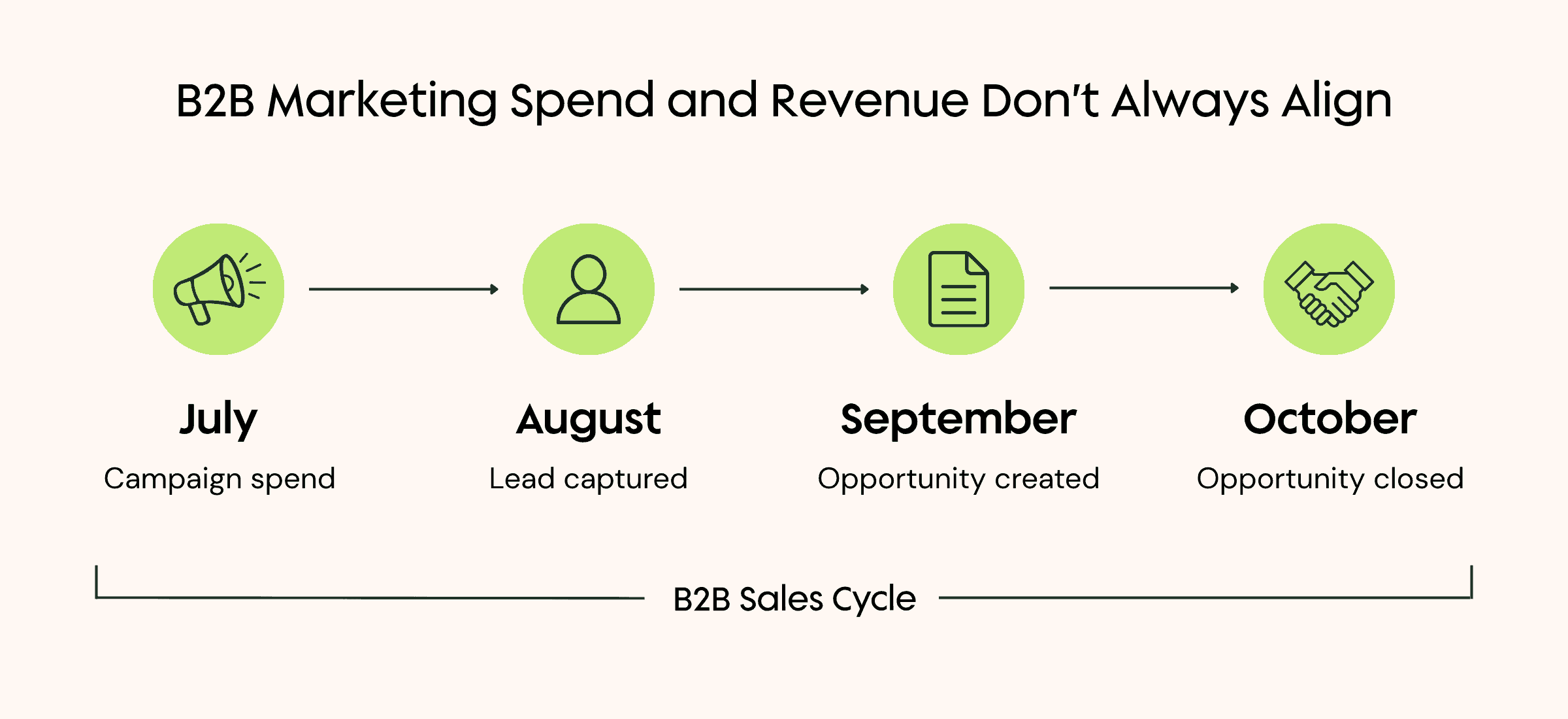
A more thoughtful approach considers the average length of the sales process and evaluates marketing performance over a time horizon that reflects how customers actually buy. For instance, if you know your average sales cycle length, you can do cohort analysis and lag the data. Say you spent $50,000 in Q3 and closed deals worth $200,000 in Q4. If your average sales cycle is one quarter, you can attribute Q4 wins back to Q3 spend.
The right reporting window will vary by business, but the same ground rules apply: Like other revenue metrics, ROAS should be interpreted in the context of the sales cycle that produced the revenue.
Use ROAS to Compare Performance at the Right Level
Once marketing spend and attributed revenue are connected, ROAS can be evaluated at different levels depending on the question being asked, from an individual campaign to a broader channel or program. That flexibility is useful because executives may care about overall marketing efficiency while individual campaign managers need more granular comparisons.
Looking across those levels can reveal different performance patterns. An individual campaign may help explain a specific result, while broader channel or program reporting can show where marketing investments are consistently contributing to pipeline and revenue over time.
Extend Attribution From Revenue to Profit
The third level of the measurement framework takes the analysis beyond revenue metrics and into profit and margin metrics. For organizations with connected sales and financial data, attribution can extend beyond closed revenue to provide an even clearer view of marketing performance.
When our work at Growth Heroes gets to this level of detail, our clients are impressed. Most have previously never been able to prove ROAS this precisely. It’s not that hard — you just need to understand how websites track visitors and how Salesforce campaigns work.
We saw the value of this connected approach firsthand with our work at System Scale, where we set up all this automation, tracked ROAS, and helped them achieve large profit growth. Because we did their marketing and invoicing in Salesforce, we could even calculate profit margin. Consider a $100,000 deal with a 30% margin. That represents $30,000 in profit before accounting for marketing costs. If $5,000 in campaign spend contributed to acquiring that business, the organization can evaluate marketing performance based not only on attributed revenue, but also on its contribution to actual profit. When you can show that real world example, businesses keep investing in the work because they see the direct profit impact.
Unifying Marketing, Sales, Service, and Finance on Salesforce—at Scale
“Growth Heroes does not just do the Salesforce technical work—they challenge us with business process improvements, help support our power users, and led discovery when we completed a large acquisition earlier this year. They quickly turned Salesforce into a profit center that is the foundation for our growth. If you are looking for a truly strategic partner that you can trust, I highly recommend them.”

Mike Sales
CEO, System Scale
Salesforce Campaign Influence and ROAS FAQs
What is Salesforce Campaign Influence?
Salesforce Campaign Influence connects campaigns with opportunities so organizations can understand which marketing activities contributed to pipeline and revenue. Depending on the attribution model used, one or more campaigns may receive credit for influencing an opportunity.
How do you get started with marketing metrics in Salesforce?
Start by defining your lead funnel and lead sources. Understand where your leads come from and how you qualify them. Then build a simple campaign structure that mirrors your marketing efforts. Finally, implement UTM tracking on your website forms and map those UTMs to Salesforce campaigns.
How do you calculate ROAS in Salesforce?
ROAS compares attributed revenue with marketing spend. In Salesforce, that means bringing campaign influence, opportunity revenue, and campaign cost data into a consistent reporting framework so the resulting comparison reflects the same attribution methodology.
Which attribution model is best for B2B marketing?
There is no single model that fits every B2B organization. First touch works for businesses that prioritize top-of-funnel awareness. Last touch works if they care about what closes deals. Even distribution is best if they run multi-touch campaigns and want credit spread across all interactions. The right choice depends on the question the organization wants the data to answer.
Why does the B2B sales cycle matter when measuring ROAS?
B2B marketing spend and closed revenue often occur in different reporting periods. A campaign may generate engagement or pipeline months before the associated opportunity closes, so ROAS should be evaluated over a time horizon that reflects the organization’s actual sales cycle.
Can Salesforce measure marketing ROI if attribution data is incomplete?
Yes, attribution can still be useful even when every touchpoint is not captured. Consistent source data, campaign definitions, and attribution rules can provide a reliable basis for comparing performance over time and identifying where marketing investments are contributing to pipeline and revenue.
Build a Clearer View of Marketing ROI in Salesforce
If you’re looking to connect campaign influence, marketing spend, pipeline, and revenue in Salesforce, Growth Heroes can help you determine the attribution and reporting approach that makes sense for your business.